
Medical Colleges in Russia: The Complete, Verified Guide for Indian Students 2026

Medical colleges in Russia remain one of the most accessible, English-medium routes into a medical career for Indian students who've cleared NEET but can't secure an affordable seat at home.
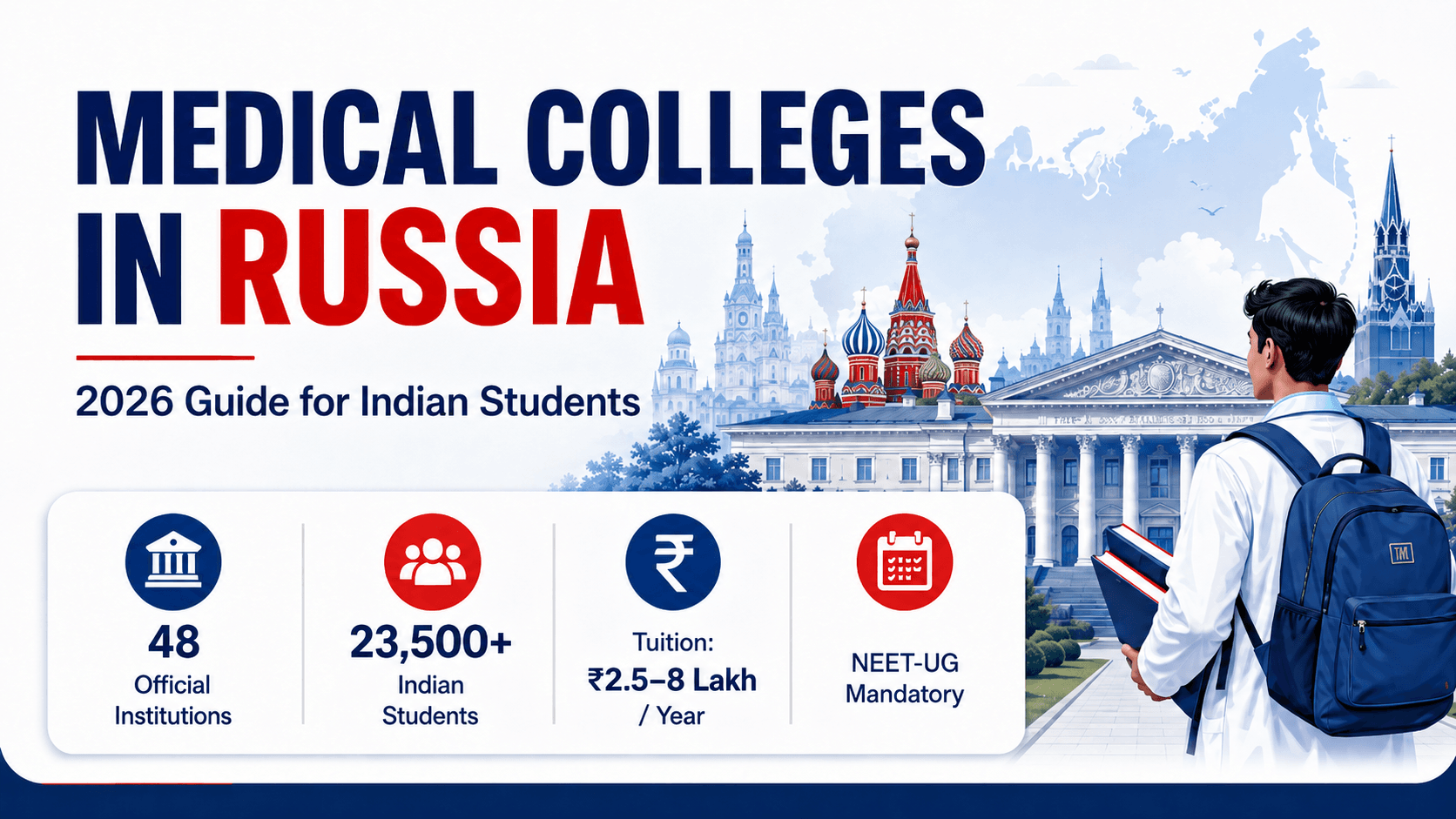
Russia has 48 medical institutions officially rated by its Ministry of Healthcare and Ministry of Education & Science, as compiled by the Indian Consulate in St. Petersburg. Roughly 23,500 Indian students are currently enrolled across Russian medical universities. Tuition runs approximately ₹2.5–8 lakh a year for a 6-year, English-medium MBBS-equivalent programme, and the NEET-UG qualification is mandatory before you can apply.
Choosing among medical colleges in Russia means separating three different things that most articles blur together: Russia's own official rating of its institutions, marketing-driven "top 10" lists built by admission agents, and the specific regulatory status that determines whether a degree lets you practise in India. This guide keeps those three threads distinct, sources every regulatory claim to an official body (NMC, the Indian Consulate, or NBEMS), and flags anywhere the publicly available data is incomplete or unverifiable rather than repeating the confident-sounding but unsourced numbers that circulate on agent websites.
What Is a "Medical College in Russia"? (Definition and Overview)
A medical college in Russia is a government-run university or academy authorized by the Russian state to award a "Specialist Diploma in General Medicine" a qualification treated as equivalent to an Indian MBBS for the purpose of India's foreign-graduate licensing exams, provided the institution and programme meet NMC's recognition criteria.
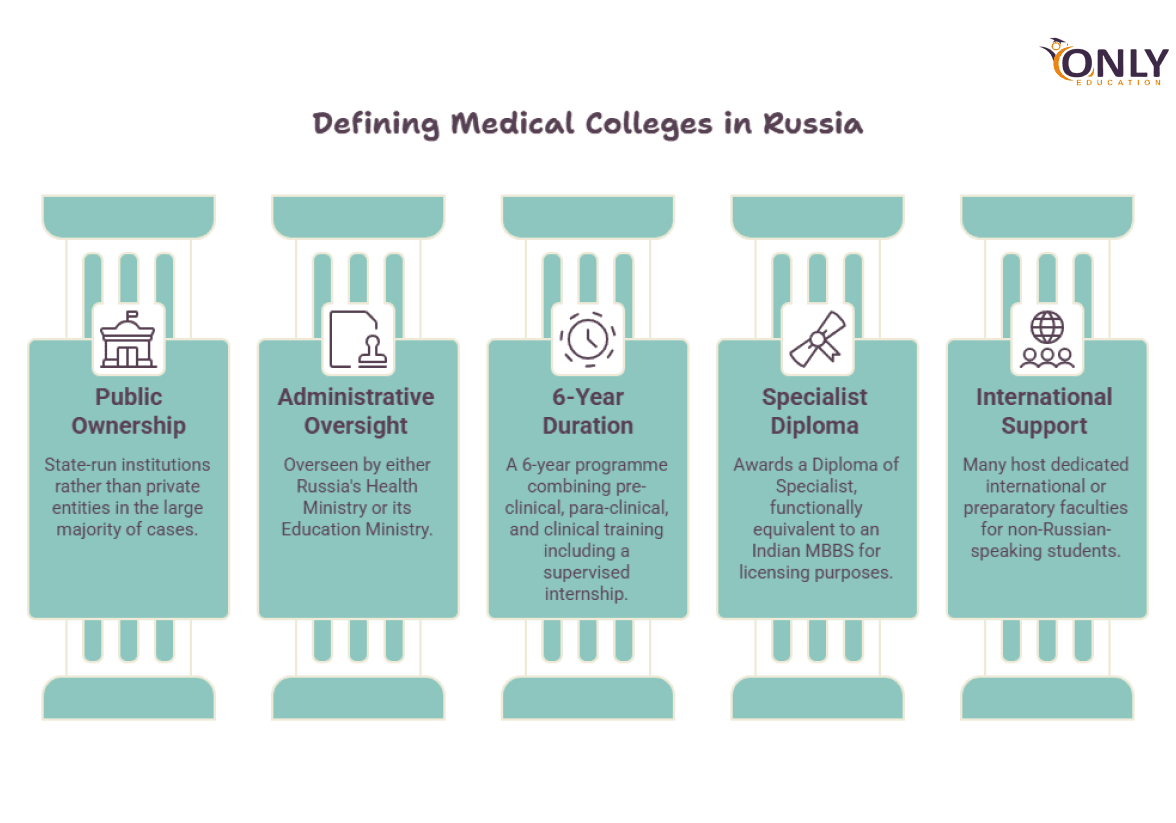
Technically, Russian universities don't award a degree literally called "MBBS", which is an Indian/British-system term. They award a Specialist Diploma after a 6-year programme combining pre-clinical, para-clinical, and clinical training. Indian counsellors and agents refer to this loosely as "MBBS in Russia" because the National Medical Commission (NMC) treats it as functionally equivalent for licensing purposes, subject to the university appearing in the correct international directories.
Key Facts:
- 48 institutions appear across the two official Indian Consulate rating categories (28 under Russia's Ministry of Healthcare, 20 under the Ministry of Education & Science)
- Roughly 45–50 Russian universities are commonly cited as offering English-medium instruction to international students
- The formal Russian qualification is a "Diploma of Specialist", not a bachelor's-then-doctorate structure as in the US
What defines these institutions:
- Public (state-run), not private, in the large majority of cases
- Overseen administratively by either Russia's Health Ministry or its Education Ministry this is a bureaucratic distinction, not a quality ranking
- Typically 6 years long, including a supervised clinical internship
- Many host dedicated international/preparatory faculties for non-Russian-speaking students
Example: A student comparing Kazan State Medical University (listed under the Health Ministry) with RUDN University (listed under the Education Ministry) is comparing two different administrative categories of Russian oversight, not two different quality tiers.
Expert Insight: Don't assume "Health Ministry" institutions automatically outrank "Education Ministry" institutions, or vice versa. The categorisation reflects which Russian government body administers the university, not an official quality hierarchy.
Bottom line: "Medical college in Russia" refers to a government-authorised institution awarding a Specialist Diploma that NMC can treat as MBBS-equivalent but only if that specific university currently meets NMC's recognition conditions.
Why Indian Students Choose Medical Colleges in Russia
Indian students choose Russia primarily for cost. Total programme costs are typically well below private medical college fees in India combined with English-medium instruction, a well-established multi-decade Indian student pipeline, and admission that depends on NEET qualification rather than a separate, more competitive entrance test.
Government medical seats in India remain limited relative to the number of NEET-qualified aspirants, and private college fees in India can be substantially higher than a full Russian MBBS programme. That cost and access gap not superior academic prestige is the primary driver behind Russia's popularity.
Key Facts:
- Around 23,500 Indian students are currently enrolled in Russian medical universities, according to Indian Embassy data reported by Careers360
- Total 6-year costs in Russia are commonly well under private-college costs in India for an equivalent seat
- Indian student associations and support networks are established in most major university cities (Moscow, Kazan, St. Petersburg, Volgograd, and others)
Common reasons cited:
- Lower total cost of a complete MBBS-equivalent programme
- English-medium instruction at most internationally facing universities
- No separate university entrance exam beyond NEET qualification
- Decades of continuous Indian enrolment, meaning established support infrastructure
Example: A student who qualifies for NEET but doesn't secure a seat in an Indian government college due to high cutoffs and can't afford private-college fees in India may find a Russian university's total cost more accessible for the same eventual eligibility to sit India's licensing exam.
Expert Insight: Affordability and easier admission are not the same as guaranteed career outcomes. The FMGE/NExT screening step still gates practice in India regardless of which country you studied in, treating Russia as an accessible but still rigorous path, not a shortcut around competition.
Bottom line: Russia's appeal is primarily economic and logistical, not a claim of academic superiority. Plan your FMGE/NExT preparation accordingly rather than assuming enrolment alone secures your career.
List of Top Medical Colleges in Russia (Official, Government-Verified)
The only India-facing official reference list of Russian medical institutions comes from the Consulate General of India in St. Petersburg, compiled from ratings by Russia's own Ministry of Education & Science, Ministry of Healthcare, and independent agencies (RAEX Experts, the European ARES standard, and Forbes Rating Vuzov). It splits 48 institutions into two administrative categories.
This is the single most load-bearing table on this page, and the one most agent-run "top 10" articles skip entirely in favour of their own curated shortlists.
A. Institutions under Russia's Ministry of Healthcare
# | University |
| 1 | The First Moscow State Medical University named after Sechenov |
| 2 | The First St. Petersburg State Medical University, named after Pavlov |
| 3 | Russian National Research Medical University named after N. I. Pirogov |
| 4 | Kazan State Medical University |
| 5 | Siberian State Medical University |
| 6 | Voronezh State Medical University, named after Burdenko |
| 7 | Ryazan State Medical University, named after Pavlov |
| 8 | Kursk State Medical University |
| 9 | Volgograd State Medical University |
| 10 | Altai State Medical Academy |
| 11 | Astrakhan State Medical University |
| 12 | Bashkir State Medical University |
| 13 | Irkutsk State Medical University |
| 14 | Kuban State Medical University |
| 15 | Orenburg State Medical University |
| 16 | Rostov State Medical University |
| 17 | Saratov State Medical University |
| 18 | Northern State Medical University |
| 19 | Smolensk State Medical University |
| 20 | Stavropol State Medical University |
| 21 | Tver State Medical University |
| 22 | Dagestan State Medical University |
| 23 | Saint Petersburg State Paediatric Medical Academy |
| 24 | Nizhny Novgorod State Medical Academy |
| 25 | Perm State Medical University, named after E. A. Vagner |
| 26 | Yaroslavl State Medical University |
| 27 | North Ossetian State Medical Academy |
| 28 | Kemerovo State Medical University |
B. Institutions under Russia's Ministry of Education & Science
# | University |
| 1 | Russian People's Friendship University (RUDN) |
| 2 | Crimean Federal University named after V. I. Vernadsky |
| 3 | Kazan (Volga) Federal University |
| 4 | Belgorod State National Research University |
| 5 | Penza State University |
| 6 | Far Eastern Federal University |
| 7 | North-Eastern Federal University named after M. K. Ammosov |
| 8 | Novosibirsk National Research State University |
| 9 | National Research Nuclear University "MEPhI" |
| 10 | Orel State University |
| 11 | Tula State University |
| 12 | Tambov State University, named after G. R. Derzhavin |
| 13 | Mari State University |
| 14 | Mordovia State University named after N. P. Ogarev |
| 15 | Ulyanovsk State University |
| 16 | Immanuel Kant, Baltic Federal University |
| 17 | Chuvash State University, named after I. N. Ulyanov |
| 18 | Kabardino-Balkarian State University named after H. M. Berbekov |
| 19 | Chechen State University |
| 20 | Pskov State University |
Key Facts:
- 48 total institutions across both official categories (28 + 20)
- Ratings draw on inputs from Russia's own ministries plus RAEX Experts, ARES, and Forbes Rating Vuzov
- Appearing on this list is a strong positive signal but is administratively separate from NMC's own recognition process
Expert Insight: Being on this government-compiled list is necessary due diligence but not sufficient on its own. NMC does not directly accredit foreign universities it recognises graduates of institutions listed in the World Directory of Medical Schools (WDOMS) and FAIMER database whose graduates meet India's screening requirements. Cross-check a university's current WDOMS/FAIMER and NMC status directly before paying any fee at nmc.org.in and wdoms.org.
Bottom line: Start your shortlist from this official list, then independently verify the current recognition status for the specific university you're considering. Don't stop at the list alone.
Best Medical Colleges in Russia: Top 10 Recommended Institutions
Cross-referencing the official Consulate list with independent Russian rankings and the institutions most consistently mentioned across current study-abroad resources produces a shortlist of ten universities most often recommended to Indian applicants, led by Sechenov University in Moscow, Russia's oldest medical school.
- Sechenov First Moscow State Medical University, founded in 1758, Russia's oldest medical school, with a large international research footprint and one of the country's most internationally visible medical brands.
- Pirogov Russian National Research Medical University (RNRMU), one of Russia's largest medical schools, with an extensive clinical training network across Moscow-area hospitals.
- Kazan State Medical University: a long-standing choice among Indian applicants, known for structured clinical rotations.
- Kursk State Medical University: a mid-sized, frequently cited for manageable class sizes and dedicated international-student support services.
- Perm State Medical University an established Health Ministry institution popular with cost-conscious applicants.
- Bashkir State Medical University one of the more budget-friendly options, with a sizeable existing Indian student community.
- RUDN University (Peoples' Friendship University of Russia) an Education Ministry institution with one of the most internationally diverse student bodies in Russia.
- Volgograd State Medical University a long-established medical faculty with decades of experience hosting international students.
- Crimean Federal University named after V. I. Vernadsky listed under the Education Ministry; given Crimea's disputed international status, independently confirm current recognition and visa/travel implications before applying here specifically.
- Tver State Medical University one of Russia's older medical institutions, generally recommended for academic consistency.
Key Facts:
- Sechenov University is Russia's oldest medical school (founded 1758) and appears in global rankings such as QS World University Rankings, though the exact global rank varies meaningfully between ranking providers and years treat any single specific rank number you see quoted online with caution
- No India-facing regulatory body publishes an audited, university-wise FMGE/NExT pass-rate ranking for Russian institutions
Example: A student prioritising international research reputation and willing to pay a premium might shortlist Sechenov or Pirogov first; a student prioritising affordability might instead compare Bashkir State or Altai State Medical Academy.
Expert Insight: Treat every "top 10" list including this one as a starting shortlist for further due diligence, not a definitive, outcomes-audited ranking. The single most useful filter remains independent verification of current NMC/WDOMS status, not position on a marketing list.
Bottom line: These ten are reasonable starting points for research, but your final decision should rest on verified recognition status, transparent total cost, and fit with your budget, not name recognition alone.
Eligibility Criteria for Medical Colleges in Russia
You need a minimum 50% aggregate in Physics, Chemistry, and Biology in Class 12 (40% for NMC-recognised reserved categories), a qualifying NEET-UG score, and you must be at least 17 years old at the time of admission, with a passport valid well beyond your intended course duration.
These are the floor requirements set by NMC for any Indian student pursuing MBBS abroad Russia included. Meeting them makes you eligible to apply; it doesn't guarantee admission to any specific university, which may set its own additional criteria.
Key Facts:
- Minimum 50% aggregate PCB in Class 12 (general category); 40% for NMC-recognised reserved categories
- NEET-UG qualification is mandatory for Indian citizens pursuing MBBS in any foreign country, not just Russia
- Minimum age of 17 years at admission
- Passports with at least 18 months' remaining validity are commonly required for visa processing
Full eligibility checklist:
- Class 12 pass with Physics, Chemistry, and Biology, meeting the minimum aggregate
- Qualifying NEET-UG percentile (50th percentile general category, 40th percentile reserved categories, per NTA norms)
- Minimum age 17 at the time of admission
- Valid passport with sufficient remaining validity
- Confirmation that the specific programme is fully English-medium
Example: A student with a 48% aggregate in PCB under the general category would not meet NMC's threshold even with a qualifying NEET score, and could only proceed through a reserved-category route if they are genuinely eligible for that category under applicable rules.
Expert Insight: NMC's eligibility criteria are the regulatory floor, not a university's actual admission bar always confirm the specific university's own current requirements in writing, since some set higher internal thresholds.
Bottom line: Meeting NMC's eligibility floor is mandatory but not sufficient verify both NMC's criteria and the individual university's own admission requirements before applying.
Admission Process: Step-by-Step Guide
The admission process runs from eligibility verification and university shortlisting, through receiving an official invitation letter, applying for a Russian student visa, and completing pre-departure formalities typically taking several weeks to a few months depending on document attestation timelines.
Steps:
- Verify eligibility confirm NEET qualification, Class 12 marks, and age criteria
- Shortlist NMC-eligible universities cross-check the official Consulate rating list and current WDOMS/FAIMER listing
- Apply directly through the university's official international admissions office avoid unregistered intermediaries promising "guaranteed seats" without verifiable documentation
- Receive an official invitation/admission letter from the university
- Apply for a Russian student visa, submitting the invitation letter, passport, NEET scorecard, and attested academic documents
- Complete mandatory health insurance and pre-departure formalities
- Travel and enrol, completing local registration with the university and the Indian embassy/consulate
Documents Typically Required
- Valid passport with adequate remaining validity
- NEET-UG scorecard
- Class 10 and Class 12 mark sheets and certificates (attested/apostilled as required)
- Birth certificate
- Passport-size photographs
- Medical fitness certificate
- University invitation/admission letter
- Completed visa application and fee
Key Facts:
- Indian academic documents typically require an apostille or embassy attestation before they're accepted abroad
- Visa processing timelines commonly run several weeks; delays are most often caused by document attestation, not the visa step itself
Example: A student who starts document attestation only after receiving the university's admission letter often loses several weeks compared to a student who begins attestation in parallel with shortlisting universities.
Expert Insight: Run document attestation and university shortlisting in parallel rather than in sequence attestation is usually the real bottleneck in the timeline, not the visa application itself.
Bottom line: Start paperwork early and in parallel with your university research; sequencing these steps one after another is the single most common cause of missed intakes.
Fees and Cost of Studying at Medical Colleges in Russia
Tuition for MBBS-equivalent programmes in Russia typically ranges from roughly ₹2.5 lakh to ₹8 lakh per year depending on the university and city, with total six-year costs (tuition plus hostel and living expenses) commonly falling between roughly ₹20 lakh and ₹45 lakh though premium institutions can exceed that range.
Cost component | Approximate range (per year) |
| Tuition fee | ₹2.5 lakh – ₹8 lakh |
| Hostel/accommodation | ₹50,000 – ₹1.5 lakh |
| Food and living expenses | ₹1 lakh – ₹2 lakh |
| Mandatory health insurance | ₹10,000 – ₹25,000 |
| Visa and miscellaneous | Varies by year and consulate |
Key Facts:
- Budget-tier universities are widely cited (by third-party study-abroad aggregators, not official sources) as costing roughly ₹21–23 lakh all-in for the full programme; premium institutions are commonly cited in the ₹40–85 lakh range depending on the source treat all such aggregate totals as estimates pending your own written confirmation
- Fee figures fluctuate with currency exchange rates and individual university policy changes
Example: Comparing a budget-tier university against a premium institution like Sechenov can show a multiple-fold difference in total cost for the same underlying NMC-recognition pathway the degree of prestige does not change your FMGE/NExT eligibility.
Expert Insight: Request a current, itemised, signed fee structure directly from the university's official admissions office before making any payment. Public fee estimates including the ranges above vary across sources and should be treated as a planning reference, not a financial commitment.
Bottom line: Budget conservatively using the higher end of published ranges, and always get final costs confirmed in writing before transferring any money.
Course Duration, Curriculum, and Medium of Instruction
The MBBS-equivalent programme in Russia is generally six years, combining pre-clinical, para-clinical, and clinical training with hospital-based rotations, followed by (or including) a 12-month supervised clinical internship and current NMC rules require the entire programme to be conducted in English for recognition purposes.
Structure:
- Years 1–5: Pre-clinical and para-clinical theory combined with progressively increasing clinical rotations
- Final year / separate internship year: Supervised clinical internship
Key Facts:
- NMC guidelines for foreign medical graduates commonly cite a minimum of 54 months of academic study plus a 12-month internship
- All instruction, examinations, and clinical rotations must be conducted in English for the degree to meet NMC's recognition criteria
- Programmes with partial Russian-language instruction can create recognition complications later
Example: A programme that teaches early pre-clinical years partly in Russian, even if later clinical years shift to English, may not meet NMC's "fully English-medium" expectation this is worth confirming explicitly rather than assuming.
Expert Insight: Get the medium-of-instruction commitment in writing, ideally reflected on the official transcript language, rather than relying on a verbal assurance from an admissions counsellor or agent.
Bottom line: Duration and structure are fairly standardised across Russian universities, but medium-of-instruction compliance varies enough that it deserves independent verification per university.
NMC Recognition, FMGE and NExT: What's Actually True in 2026
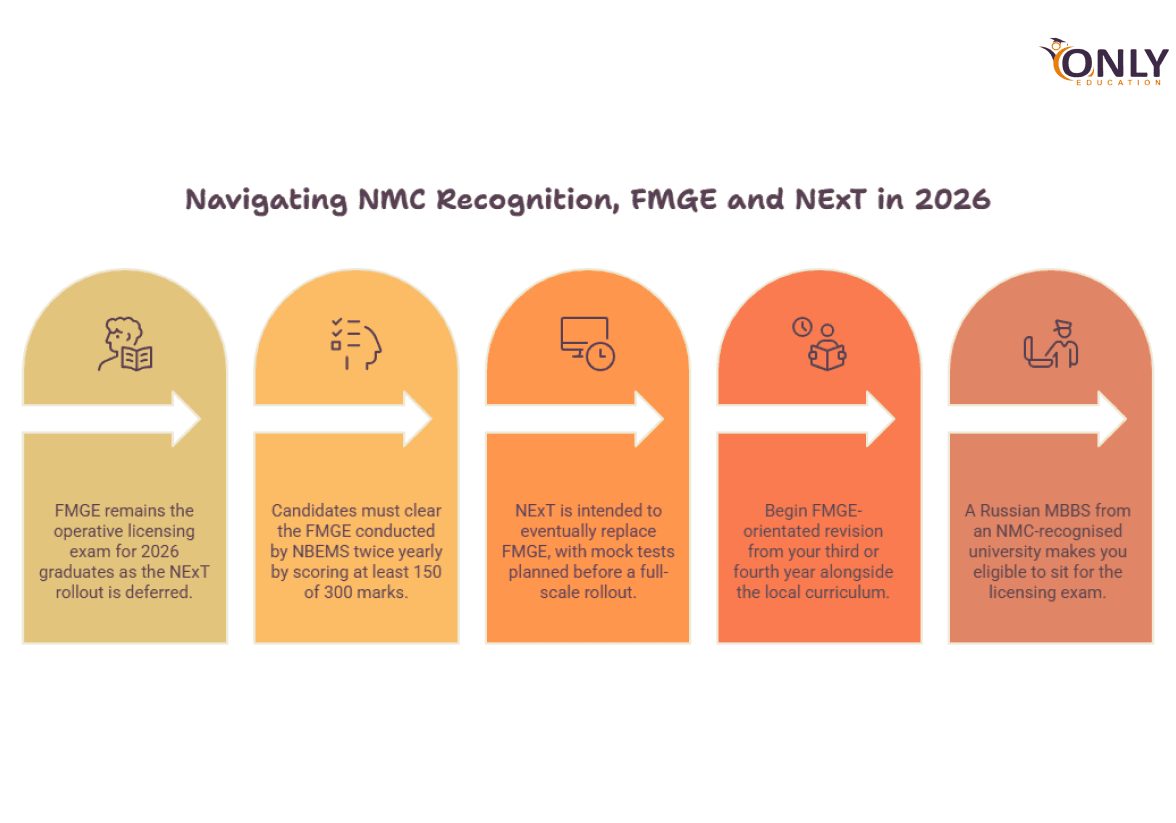
FMGE (the Foreign Medical Graduate Examination) remains, as of 2026, the operative licensing exam Indian citizens must clear after an MBBS abroad, including from Russia. NExT (National Exit Test) is legally intended to eventually replace it, but its full rollout has been officially deferred so 2026 graduates should prepare for FMGE under the current system.
This is the section where outdated and conflicting information circulates most, so here are the verified specifics.
Key Facts:
- FMGE is conducted twice yearly (June and December) by the National Board of Examinations in Medical Sciences (NBEMS); a candidate needs at least 150 of 300 marks (50%) to pass
- Recent overall FMGE pass rates (all foreign medical graduates, not Russia-specific): 29.62% in December 2024, 18.61% in June 2025, and 23.9% in December 2025, per NBEMS results reported by Careers360
- NExT was introduced under NMC's National Exit Test Regulations, 2023, intended to eventually replace both FMGE and NEET-PG as a single licensing exam
- NMC leadership has indicated NExT's full-scale rollout is deferred, with mock tests planned over several years before transition
- NBEMS does not publicly publish country-wise or university-wise FMGE pass-rate breakdowns
Example: A 2026 graduate who assumes NExT is already fully active and skips FMGE registration would miss the actual operative licensing exam for their cohort FMGE remains the exam in force for the current cycle.
Expert Insight: Begin FMGE-orientated revision (or NExT preparation, once its format is finalised) from your third or fourth year alongside the local curriculum, rather than starting cold after returning to India. Given recent pass rates have ranged from roughly 18% to 30% across all foreign graduates, early and structured preparation meaningfully changes your odds.
Bottom line: A Russian MBBS from an NMC-recognised university makes you eligible to sit India's licensing exam it does not guarantee you'll pass it. Treat FMGE/NExT preparation as a core part of your six-year plan, not an afterthought.
Medical Colleges in Russia vs Other Popular MBBS-Abroad Destinations
Russia sits in the affordable-to-moderate cost band among popular MBBS-abroad destinations for Indian students and shares one universal requirement with every alternative: NEET-UG qualification is mandatory for Indian citizens pursuing MBBS in any foreign country under current NMC rules, not just Russia.
Destination | NEET required | Typical duration | Instruction medium | Relative cost positioning | Note |
| Russia | Yes | ~6 years incl. internship | English at internationally-facing universities | Low–Moderate | Large, multi-decade Indian student base |
| Georgia | Yes | ~6 years | English | Low–Moderate | Popular recent alternative destination |
| Philippines | Yes | Often a pre-med bridge + medicine structure | English | Moderate | US-influenced curriculum style |
| Central Asia (e.g., Kyrgyzstan, Uzbekistan) | Yes | ~5–6 years | English | Low | Rapidly growing option in recent years |
| Ukraine | Yes | ~6 years | English | Historically Low–Moderate | Medical education access has been significantly disrupted since 2022 amid the ongoing conflict; independently verify current status before considering |
Key Facts:
- NEET-UG is a uniform NMC requirement across every foreign MBBS destination; it is not something specific to, or avoidable by choosing, Russia
- Relative cost positioning narrows once hidden costs (agent fees, coaching, travel, insurance) are factored in across destinations
Expert Insight: Choose based on verified recognition status and your family's risk tolerance for regulatory or geopolitical change not solely on the headline tuition figure, since total costs converge more than marketing materials suggest once hidden expenses are included.
Bottom line: Russia is a reasonable option within a broader field of NMC-relevant destinations; it isn't uniquely cheaper or uniquely safer than every alternative, so compare verified specifics rather than country reputation alone.
Pros and Cons of Studying at Medical Colleges in Russia
The clearest advantages are affordability relative to Indian private colleges, English-medium availability, and an established support ecosystem; the clearest drawbacks are the historically sub-30% FMGE pass rate across all foreign graduates, variable name-recognition of specific universities in India, and the need for ongoing independent verification of recognition status.
Pros | Cons |
| Lower total cost than most Indian private medical colleges | FMGE/NExT pass rates for all foreign graduates have recently ranged from ~18% to 30%. |
| English-medium instruction at internationally facing universities | Degree/university name recognition in India varies significantly |
| Decades-long, established Indian student support ecosystem | Climate and cultural adjustment for students unfamiliar with Russia |
| Government-run (not private, profit-driven) institutions in most cases | Regulatory and geopolitical conditions require ongoing monitoring rather than a one-time check. |
Key Facts:
- Recent FMGE pass rates for all foreign medical graduates combined: 18.61% (June 2025), 23.9% (December 2025), 29.62% (December 2024)
- No university-specific, India-official pass-rate data is publicly available to validate agent claims about particular Russian universities
Example: A student weighing "lower upfront tuition" against "added FMGE coaching costs and additional attempts" is really comparing total cost of becoming licensed, not just total cost of completing the degree.
Expert Insight: Budget for FMGE/NExT coaching as a mandatory line item in your financial plan from day one, not an optional extra you'll consider only if the first attempt doesn't go well.
Bottom line: Russia's advantages are real but come with a licensing-exam risk shared by every foreign MBBS destination factor that risk into your cost-benefit analysis explicitly.
Safety and Student Life in Russia
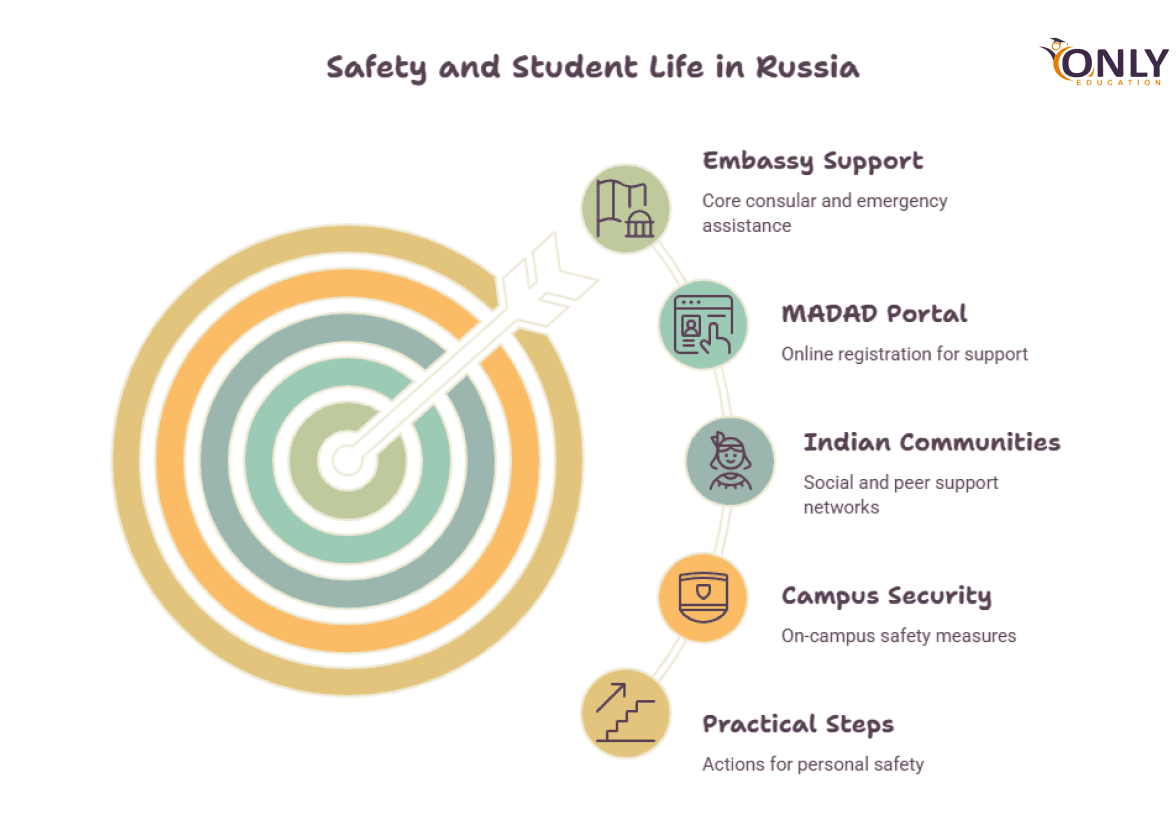
Indian students in Russia generally have access to embassy-backed support through the MADAD portal, established Indian communities in major university cities, and standard campus security measures but students should register with the embassy on arrival and check the current Ministry of External Affairs travel guidance before finalising travel plans.
Key Facts:
- The MADAD portal allows Indian students abroad to register and access consular/embassy support during emergencies
- Established Indian communities and student associations exist in major university cities including Moscow, Kazan, and St. Petersburg
- Campus security measures at most universities commonly include ID/biometric access and CCTV monitoring in hostels and common areas
Practical safety steps:
- Register with the Indian Embassy/Consulate and on the MADAD portal immediately after arrival
- Carry identification and a copy of your passport/visa at all times
- Stay in university-approved hostels and avoid isolated areas at night
- Maintain regular contact with family through agreed channels
- Stay informed through official embassy communications rather than informal agent updates
Expert Insight: Registering on the MADAD portal and with the local embassy is the actual mechanism through which support reaches you in an emergency treat it as a mandatory first step on arrival, not an optional formality.
Bottom line: Standard precautions and embassy registration cover most day-to-day safety concerns, but always check the current MEA travel advisory before travel, since geopolitical conditions can change and this guide cannot substitute for that real-time check.
Scholarships and Financial Assistance
For the 2026–27 academic year, the Russian government announced 300 scholarships for Indian students spanning multiple disciplines including medicine; these cover tuition fees only, don't require Russian language proficiency, exclude Lomonosov Moscow State University and MGIMO, and are applied for through the official portal education-russia.com.
Key Facts:
- 300 scholarships announced for Indian students across UG, specialist, master's, PhD, and advanced-training levels for 2026–27
- Coverage is tuition-only; students should budget separately for living costs
- Applicants can select a "need to learn Russian" option if they don't already speak the language
- The scheme excludes Lomonosov Moscow State University and MGIMO specifically
How to apply:
- Apply directly through the official portal, education-russia.com
- Confirm your intended discipline (medicine) is eligible under the current cycle
- Avoid third-party agents claiming to guarantee scholarship placement for a fee
Expert Insight: Scholarship seats are limited relative to the tens of thousands of Indian applicants pursuing MBBS abroad each year apply early and directly through the official portal rather than through an intermediary claiming special access.
Bottom line: Government scholarships exist and are worth pursuing, but they cover tuition only and are competitive treat them as a potential cost reduction, not your primary financial plan.
Career Scope After Graduating from a Medical College in Russia
Graduates can pursue registration to practice in India after clearing FMGE (or NExT once fully implemented) and completing NMC-mandated internship requirements, or explore practice and further study opportunities in Russia or other countries, subject to each country's own separate licensing rules.
Pathways after graduation:
- Practice in India: Clear FMGE/NExT, complete the required internship, and register with the applicable State Medical Council and the National Medical Register
- Postgraduate study in India: Eligibility currently runs through NEET-PG (with NExT expected to eventually unify this process)
- Practice in Russia or the CIS region: Subject to that country's own separate licensing and registration requirements
- International licensing elsewhere (e.g., USMLE, PLAB): Entirely separate exams regulated by the respective countries, unrelated to India's FMGE/NExT process
Expert Insight: Decide relatively early in your programme whether your primary goal is practising in India, pursuing further international licensing, or both the preparation timelines for FMGE/NExT versus something like USMLE diverge significantly and benefit from early planning rather than a last-minute decision.
Bottom line: A Russian medical degree opens multiple pathways, but each one requires its own separate licensing exam and registration process there is no path that skips a qualifying exam entirely.
How to Choose the Right Medical College in Russia (Decision Checklist)
Treat university selection as a sequence of pass/fail gates official rating list membership, current NMC/WDOMS verification, confirmed English-medium instruction, and a written fee structure rather than a single ranked comparison, since failing any one gate should rule out a university regardless of its other appeal.
Checklist, in order:
- Confirm the university appears on the official Indian Consulate rating list
- Independently verify current WDOMS/FAIMER listing and NMC recognition status directly through official channels
- Get written confirmation that the entire programme is conducted in English
- Request a current, itemised, signed fee structure don't rely on published estimates alone
- Assess hostel/campus safety setup and the size of the existing Indian student community
- Check the university's access to teaching hospitals for clinical rotations
- Treat any specific FMGE/NExT "pass rate" claim for that university as informal and unverifiable unless it comes from an official source
- When in doubt, consult the Indian embassy's education cell before finalising a decision
Expert Insight: Apply this checklist as sequential gates, not a weighted scorecard. If a university fails step 2 (current NMC/WDOMS verification), no advantage on price, campus quality, or city should override that failure.
Bottom line: A disciplined, gate-by-gate verification process protects you far better than comparing marketing brochures side by side.
Common Mistakes to Avoid
The costliest mistakes are relying solely on an agent's curated list instead of the official Consulate rating and current NMC status, underestimating FMGE/NExT preparation, and failing to get total costs confirmed in writing before payment.
- Relying only on an agent's "top 10" list without independently checking the official Consulate rating list or current NMC/WDOMS status
- Skipping NEET verification a Russian admission offer never overrides the NEET requirement for Indian applicants
- Ignoring the medium of instruction enrolling in a partially Russian-taught programme can create recognition complications later
- Underestimating FMGE/NExT preparation treating it as an afterthought instead of starting structured preparation from the third or fourth year
- Not verifying total costs in writing public fee figures vary widely; get a signed, itemised cost sheet from the university directly
- Overlooking passport validity and visa lead times, which can delay or derail an entire admission cycle
Frequently Asked Questions
1. Which medical colleges in Russia are officially recognised for Indian students?
The universities listed on the Consulate General of India's official rating lists (compiled from Russia's Ministry of Healthcare and Ministry of Education & Science) are the most reliably documented starting point. Always independently cross-check current NMC/WDOMS status before applying, since government rating and NMC recognition are administered separately.
2. Is NEET mandatory for MBBS in Russia?
Yes. Indian students must qualify NEET-UG to pursue MBBS in any foreign country, including Russia, under current NMC regulations this requirement is not specific to Russia.
3. What is the minimum NEET score required for MBBS in Russia?
There's no Russia-specific cutoff you need a qualifying NEET-UG percentile (50th percentile general category, 40th percentile for NMC-recognised reserved categories, per NTA norms), not a fixed rank or score.
4. How many years is MBBS in Russia?
Typically six years, including pre-clinical, clinical, and internship phases, taught in English at universities meeting NMC's recognition criteria.
5. What is the average fee for MBBS in Russia?
Roughly ₹2.5–8 lakh per year in tuition, varying by university and city, with total six-year costs commonly in the ₹20–45 lakh range. Always confirm current figures directly with the institution before committing.
6. Is FMGE still required for Russian MBBS graduates in 2026?
Yes. FMGE remains the operative licensing exam for the 2026 cycle. NExT is intended to eventually replace it, but that transition has been officially deferred.
7. What is the difference between FMGE and NExT?
FMGE is the current twice-yearly screening exam for foreign medical graduates. NExT is a planned unified exam (covering both licensing and postgraduate admission) meant to eventually replace both FMGE and NEET-PG, though its full rollout hasn't happened yet.
8. What is the FMGE pass rate for Russian MBBS graduates specifically?
NBEMS does not publish country-wise or university-wise pass-rate data publicly. Only combined pass rates across all foreign graduates are available (recent sessions have ranged from roughly 18% to 30%).
9. Are Russian medical degrees recognised by the WHO?
Recognition relevant to Indian licensing runs through NMC and a university's listing in the World Directory of Medical Schools (WDOMS), which most institutions on the official Consulate list are part of. Always verify the current listing status directly rather than relying on a brochure claim.
10. Can I do MBBS in Russia without NEET?
No. NEET qualification is mandatory for Indian citizens pursuing MBBS abroad, including in Russia.
11. Is it safe for Indian students to study medicine in Russia?
Thousands of Indian students currently study in Russia, and most universities have established international-student support systems, embassy registration options (MADAD portal), and standard campus security. As with any study-abroad decision, check the current Ministry of External Affairs travel advisory before finalising travel.
12. What documents are required for MBBS admission in Russia?
A valid passport, NEET scorecard, Class 10 and 12 mark sheets/certificates, birth certificate, photographs, a medical fitness certificate, the university's invitation letter, and completed visa documentation.
13. Which is the oldest medical university in Russia?
Sechenov First Moscow State Medical University, founded in 1758, is widely recognised as Russia's oldest medical institution.
14. Can I get a scholarship for MBBS in Russia?
Yes for 2026–27, the Russian government announced 300 scholarships for Indian students covering multiple disciplines including medicine, applied for via education-russia.com, covering tuition only and excluding two named universities. Confirm current-cycle details directly on the official portal.
15. What is the career scope after completing MBBS in Russia?
Graduates can pursue India-based practice via FMGE/NExT and NMC/State Medical Council registration, postgraduate study via NEET-PG, or practice/further licensing in Russia or other countries subject to those countries' own separate rules.
16. Do all Russian medical universities teach in English?
No this must be confirmed specifically per university. Only genuinely English-medium programmes (not partial or mixed instruction) meet NMC's language requirement for recognition.
17. Is a medical college in Russia still valid if it isn't on the Indian Consulate's list?
Treat absence from the official list as a significant red flag requiring independent verification. The list reflects Russia's own government ratings; a university's absence doesn't automatically mean it's invalid, but it means you must verify NMC/WDOMS status directly rather than relying on this list alone.
18. Is a Russian medical qualification the same as an "MD"?
Not in the US sense. Russian universities award a Specialist Diploma in General Medicine after a 6-year undergraduate-entry programme agents sometimes market this loosely as "MD," but it functions as an MBBS-equivalent qualification for Indian licensing purposes, not a US-style postgraduate Doctor of Medicine.
19. Can I transfer between Russian medical universities mid-course?
Transfers are handled on a case-by-case basis by the universities involved and can affect your recognised study duration and NMC eligibility timeline. Confirm feasibility and NMC implications directly with both universities and, ideally, the Indian embassy's education cell before initiating a transfer.
20. Is a more expensive, higher-profile university like Sechenov worth it over a budget option?
This depends on your priorities and budget, since no official body publishes audited outcome differences (like FMGE pass rates) between specific Russian universities. A higher-profile institution may offer stronger research exposure and brand recognition; a budget institution offers a lower financial barrier for the same underlying NMC-recognition pathway. Neither guarantees a better licensing-exam outcome without proportional individual preparation.
Conclusion
Medical colleges in Russia remain one of the most accessible, English-medium routes into a medical career for Indian students who've cleared NEET but can't secure an affordable seat at home. But accessible isn't the same as risk-free. The best medical colleges in Russia, by any honest measure, aren't the ones with the flashiest agent brochure they're the ones that appear on Russia's own official government rating list, currently hold WDOMS/FAIMER and NMC-relevant status, teach entirely in English, and hand you a written, itemised fee structure before you pay anything.
If this guide leaves you with one habit, make it this: treat every claim you encounter elsewhere rankings, fee totals, "guaranteed" FMGE pass rates as something to verify against NMC, the Indian Consulate's official list, or the university's own admissions office, rather than something to accept from a counsellor's pitch. Do that consistently through shortlisting, admission, and six years of study, and a Russian medical college can be a genuinely sound path into practice. Skip that discipline, and no amount of ranking or campus prestige will substitute for it. The licensing exam waiting for you back in India doesn't check where a claim came from, only whether you were prepared for it.
Sources and Further Verification
- Consulate General of India, St Petersburg: Rating Lists of Medical Institutions in the Russian Federation
- National Medical Commission (NMC) nmc.org.in
- World Directory of Medical Schools wdoms.org
- National Board of Examinations in Medical Sciences (NBEMS) natboard.edu.in
- Official Russian government scholarship portal education-russia.com
This article reflects publicly available information as of July 2026. Regulations, fees, scholarship terms, and recognition status can change always verify current requirements directly with NMC, the specific university, and the Indian embassy/consulate before making any admission or payment decision.