
CSE vs AI Competition and Future Aspects. A Student Perspective

Choosing the right engineering branch is one of the most important decisions for every student. Among the top choices today, Computer Engineering and Artificial Intelligence stand out as the most popular and most confusing. Both offer promising futures, but they differ in competition level, learning focus, and long term opportunities.
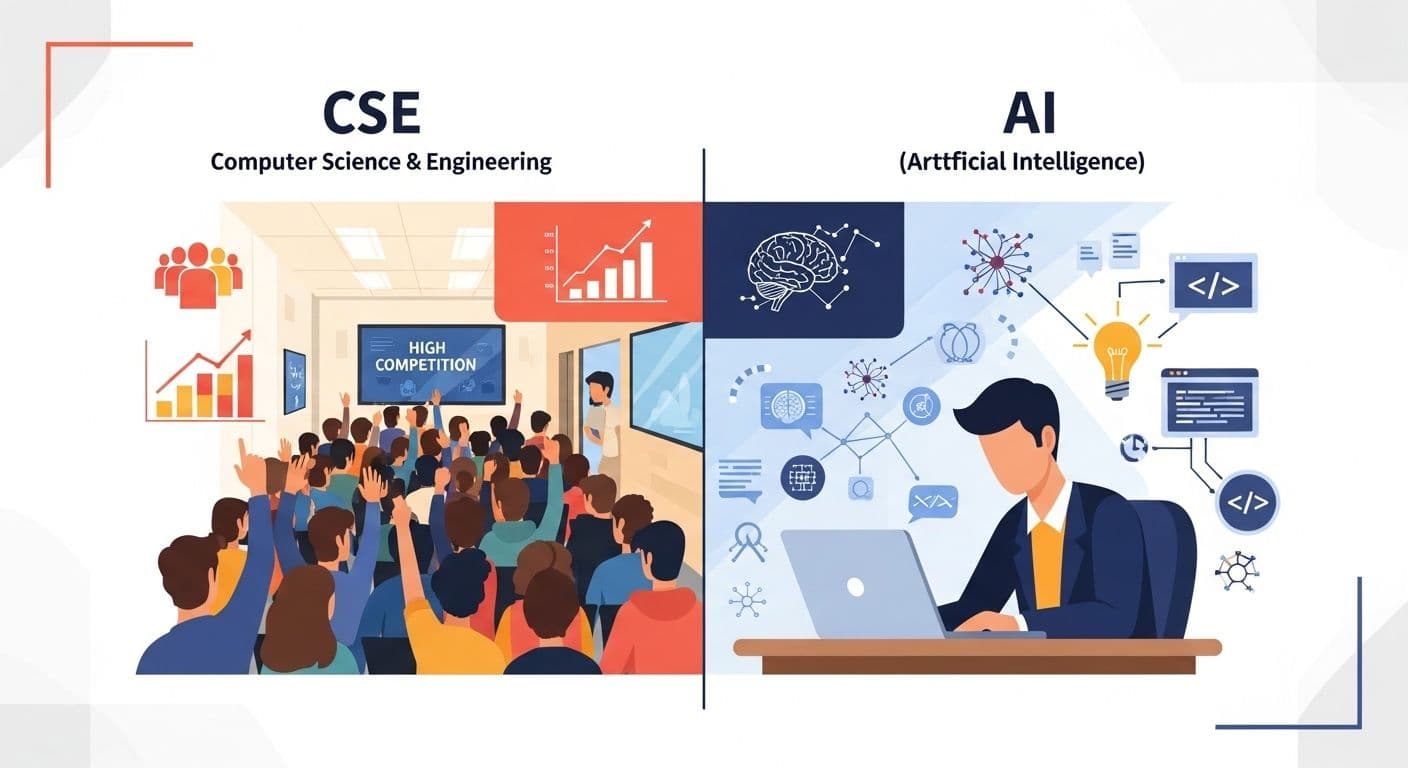
If you want maximum flexibility and aren't 100% sure what you want to specialize in, choose CSE. If you're strong in math and statistics and already know you want to build ML/AI systems, and your college offers a genuinely modern AI curriculum, choose AI. At most Indian colleges, AI is a specialization within the CSE department, not a fully separate discipline so the gap between them is smaller than it looks.
Quick Facts of CSE vs AI
Metric | CSE | AI / AI & ML |
| Typical fresher salary (India, 2026) | ₹3.5–8 LPA | ₹6–14 LPA |
| Placement success rate (approx.) | 90–98% | 85–95% |
| Admission competitiveness | Very high | High, but fewer seats overall |
| Core focus | Full computing stack: DSA, OS, networks, DBMS, architecture | ML, deep learning, NLP, computer vision, statistics |
| Math intensity | Moderate | High (linear algebra, probability & statistics from year 1–2) |
| Career flexibility | Very high any tech role | Narrower but high-growth ML/AI-specific roles |
| Is it a separate branch? | Yes, standalone | Usually a CSE specialization under AICTE norms |
(Salary and placement figures are indicative ranges compiled from multiple 2025–26 placement reports; actual outcomes vary significantly by college tier, city, and individual skills.)
CSE vs AI: The Core Difference
CSE is a broad, foundational engineering branch covering hardware, software, networks, databases, and algorithms. AI is a specialized track usually offered as a CSE specialization under AICTE norms focused specifically on building systems that learn from data: machine learning, deep learning, NLP, and computer vision.
Think of CSE as the trunk of the tree and AI as one of its fastest-growing branches. Every AI system still runs on the operating systems, databases, and software architecture principles that CSE teaches from day one. That's why most Indian universities structure AI not as an entirely separate four-year discipline but as "B.Tech CSE with specialization in AI & ML" the first two years overlap heavily with core CSE, and the specialization intensifies from around the third or fourth semester onward.
Competition and Admission Difference
CSE is the single most competitive engineering branch in India by seat demand, which pushes cutoffs higher. AI has fewer total seats and fewer offering colleges, which can mean a different sometimes lower cutoff, but it demands stronger baseline math and statistics ability once you're in.
- CSE: Highest overall demand of any engineering branch; cutoffs at top IITs/NITs are consistently among the steepest in JEE Main/Advanced counseling.
- AI/AI & ML: Fewer colleges offer it as a distinct program, so raw seat competition is lower, but the coursework is academically demanding from semester one heavy in linear algebra, probability, and statistics.
If your JEE rank doesn't clear CSE at your target college but does clear AI/AI & ML at the same or a similar-tier institute, that's a legitimate reason to consider AI provided you're genuinely comfortable with math-heavy coursework.
When Should You Decide: Before 12th, or After Year 1?
Make the CSE-vs-AI call at admission time based on your JEE rank and math comfort but treat it as a first decision, not a final one. Most colleges let CSE students formally pick an AI/ML specialization or electives from around the 3rd–4th semester, so if you're unsure at 17–18, choosing broad CSE and specializing after year 1 or 2 is a low-risk path that many students take.
The reverse starting in a dedicated AI program and later deciding you want a more general software career is harder to formalize through internal transfer, but not impossible in practice, since the shared CSE foundation in years 1–2 means an AI graduate's coursework still supports general software roles at graduation.
Eligibility Criteria for CSE and AI / AI & ML
Eligibility for both branches is identical at the entry point a valid JEE Main (or relevant state/university entrance exam) score, with a minimum of 60% aggregate in Physics, Chemistry, and Mathematics (PCM) in Class 12. There's no separate or additional eligibility bar for AI/AI & ML over standard CSE at the admission stage; the difference shows up in the coursework difficulty after you're enrolled, not in who's allowed to apply.
Where to Study AI in India: Colleges and Cutoffs
A growing number of IITs, NITs, and IIITs now offer B.Tech Artificial Intelligence or "AI & Data Science" as a distinct JoSAA counseling option alongside core CSE, though seats remain far fewer than CSE and cutoff ranks vary sharply by institute.
Illustrative 2026 JoSAA closing ranks (General category, open seats) for standalone AI/AI & Data Science programs:
Institute | Programme | Closing Rank (approx.) |
| NIT Warangal | CSE (AI & Data Science) | ~2,950 |
| NIT Karnataka, Surathkal | Computational and Data Science | ~3,470 |
| NIT Karnataka, Surathkal | B.Tech AI (JoSAA 2025 Rd 6) | ~2,815–3,579 |
| MNIT Jaipur | AI and Data Engineering | ~6,490 |
| NIT Delhi | AI and Data Science | ~6,900 |
| NIT Rourkela | B.Tech AI | ~8,000–9,100 |
| SVNIT Surat | B.Tech AI | ~8,100–12,400 |
| NIT Jalandhar | Data Science and Engineering | ~14,800 |
| NIT Patna | BTech-MTech CSE (DS specialization) | ~16,500–17,400 |
(Cutoffs shift every counseling round and year always verify current-year figures on the official JoSAA site before finalizing choices. IITs also admit into AI/Data Science programs via JEE Advanced, with cutoffs at institutes like IIT Goa, IIT Bhilai, and IIT Jodhpur typically in the ~6,000–26,000 rank range for general category depending on category and round.)
For a broader field, most private universities (e.g., SRM, GL Bajaj, Chitkara, LPU) also offer "CSE with specialization in AI & ML" with their own entrance routes or JEE Main-based admission, generally at less competitive cutoffs than the government institutes above.
Why Students Get Confused Between the Two
The confusion comes from real overlap: AI students study the same programming, database, and operating-systems fundamentals as CSE students, just with an added focus on data and intelligent systems. Marketing around AI as "the future" adds to the hype, even though most undergraduate hiring in both branches is still for general software development roles.
That's a big part of why CSE is often considered the safer choice: it keeps your options open, including the option to specialize in AI later, without requiring you to commit to a narrower path at age 17 or 18.
Curriculum: Semester-by-Semester Difference
Years 1–2 are nearly identical for both branches' programming fundamentals, DSA, and core engineering math. From year 3 onward, CSE broadens into networks, OS, DBMS, and electives, while AI narrows into mandatory ML, deep learning, NLP, and computer vision coursework.
B.Tech CSE core subjects:
- Data Structures and Algorithms (DSA)
- Operating Systems (OS)
- Computer Networks
- Database Management Systems (DBMS)
- Computer Architecture
- AI/ML offered as electives in the final two years
B.Tech AI / CSE-AI specialisation core subjects:
- Linear Algebra and Probability & Statistics (mandatory, applied early)
- Machine Learning and Deep Learning
- Natural Language Processing (NLP)
- Computer Vision
- Reinforcement Learning
- Same CSE foundation courses in years 1–2
Fees and Cost Comparison
Fee structures for CSE and AI/AI & ML are broadly similar at the same college since AI is usually a specialization within the same department though a handful of private colleges price AI/ML programs at a premium given higher current demand.
Because AI is frequently billed as a "future technology" track, some private institutions charge 5–15% more for it than standard CSE, even though the first two years of coursework are nearly identical. Always compare fee structures at the same college rather than assuming AI is universally more expensive it depends entirely on the institution.
Salary and Placement Comparison
AI/ML specialists tend to command slightly higher starting salaries than general CSE graduates at comparable colleges, but CSE offers a far larger number of total job openings, since most companies hire many more general software roles than dedicated AI/ML roles.
Factor | CSE | AI / AI & ML |
| Typical fresher package | ₹3.5–8 LPA (service-company range); ₹8–15 LPA+ at strong product companies | ₹6–14 LPA typical; ₹8–14 LPA at product companies with verified skills |
| Mid-career (3–7 yrs) | ₹8–20 LPA | ₹12–30 LPA, up to ₹40–50 LPA for deep learning/NLP specialists |
| Volume of open roles per recruiting drive | High most companies hire broadly for software roles | Lower AI/ML-specific openings are a smaller slice of total hiring |
| Top recruiters (illustrative) | Major IT services firms, product companies, startups across all sectors | Product companies, AI-focused startups, GCCs, research labs |
A useful way to think about it: a large number of campus hires are general software roles, and only a smaller share are dedicated AI/ML positions. So while an individual AI/ML offer can be more lucrative, CSE students typically see more total opportunities across a placement season.
Which Companies Actually Recruit From Each Branch?
In practice, most large recruiters from Google and Microsoft to TCS and Infosys open their campus drives to CSE, IT, AI/ML, and Data Science students together, since hiring is based on coding rounds and problem-solving ability rather than the branch name on the degree. The branch mainly affects which role you're funneled toward, not whether you get shortlisted at all.
- Product/tech giants (Google, Microsoft, Amazon, Apple, Adobe): recruit across CSE and AI/ML branches; roughly a third of recent IIT-level offers have gone to AI/ML and ML-infrastructure roles specifically.
- IT services majors (TCS, Infosys, Wipro, Accenture): recruit heavily and consistently from CSE for general software and support roles, valuing coding fundamentals, aptitude, and communication skills.
- Quant/finance firms (Goldman Sachs, Tower Research, Quadeye): recruit selectively from top-tier CSE and math-heavy branches, including AI/Data Science, for research and algorithmic roles.
- AI-focused startups and GCCs: the main destination where an AI/ML-specific degree becomes a differentiator over a general CSE degree.
Standalone AI Degree vs. CSE with an AI Specialization Which Is "Better"?
At top-tier institutes (IITs, NITs, IIITs), there's little practical difference both routes get you strong faculty, competitive placements, and real depth in ML/AI. At mid-tier or newer private colleges, a standalone AI degree carries more risk, since program quality and faculty depth vary widely; a CSE degree with an AI specialization is usually the more consistent choice because the core CSE accreditation and curriculum standards are more established.
AI vs ML vs Data Science: Don't Confuse These
AI is the broad concept of machines simulating intelligent behavior. Machine Learning (ML) is a subset of AI focused on systems that learn from data. Data Science is a related but distinct field focused on extracting insights from data using statistics, ML, and visualization not all data scientists build AI systems, and not all AI engineers work with data science tools.
Many "AI" branch names in Indian colleges are technically "AI & ML," which is more accurate the coursework centers on machine learning techniques as the practical toolkit for building AI systems.
Which Branch Should You Choose? (Decision Table)
| CSE or | ||
| Interested in coding and general software development | CSE | Broadest skill base, most job categories |
| Strong in math/statistics, wants to build ML models | AI / AI & ML | The curriculum is built around this from year one |
| Still exploring, unsure of specialization | CSE | Keeps every future option including AI open via electives |
| Set on research/innovation in ML, NLP, or computer vision | AI / AI & ML | Direct, non-negotiable coursework in these areas |
| Targeting a top-tier college (IIT/NIT/IIIT) | Either | Faculty and infrastructure strong in both; CSE electives cover AI well |
| Targeting a mid-tier or newer private college | CSE (generally safer) | More standardized foundation; less variance in curriculum quality |
College Selection: What to Look For
For CSE, prioritize overall department strength:
- Established faculty across all core CS domains, not just one trending area
- Placement records with diverse role types (SDE, systems analyst, database admin, etc.), not just headline packages
- Solid research infrastructure across computing generally, not only AI labs
For AI / AI & ML, prioritise the following:
- A curriculum that starts core ML/DL coursework by semester 3–4 (not pushed entirely to the final year)
- Faculty with active research or industry work in ML, not just a rebranded CSE syllabus
- Lab access to GPUs/compute resources, since AI coursework is hands-on and data-heavy
Rule of thumb by college tier:
- Top-tier (IITs, IIITs, NITs): You can confidently choose either CSE or the AI specialization faculty and resources are strong in both, and CSE will offer excellent AI electives regardless.
- Mid-tier or newer private colleges: Core CSE is generally the safer pick, since it guarantees a standardized foundation. You can still build AI/ML skills on the side through electives, certifications, and projects.
What If You Don't Get CSE or AI?
If your rank doesn't clear CSE or AI/AI & ML at your target college, Information Technology (IT) and Electronics & Communication Engineering (ECE) with a CS-adjacent minor or electives are the closest practical alternatives both share a meaningful chunk of core CSE coursework and are increasingly included in the same "software-eligible" campus placement drives.
- IT (Information Technology): Close to CSE in curriculum networks, databases, software development and IT graduates are frequently eligible for the same recruiter drives as CSE and AI/ML students.
- ECE with CS electives/minor: A viable path into software and even AI-adjacent roles (especially embedded AI, robotics, and signal processing) if you pick up programming and DSA through electives, but it requires more self-directed effort than IT or CSE.
- Other options: Some colleges also offer branches like "Computer Science and Business Systems" or "Information Science" that sit close to CSE worth checking curriculum overlap before assuming they're lesser alternatives.
Can You Switch Later?
Yes, in both directions, though it's easier to move from CSE into AI-adjacent roles than the reverse. CSE graduates commonly pick up AI/ML through electives, online certifications, and personal projects. AI/AI & ML graduates can move into general software roles too, since they share the same core-CSE foundation in years 1–2.
Future Scope and Opportunities
AI is not replacing core computer science it's built on top of it. CSE graduates can work in almost any sector, from software development and web design to cybersecurity and cloud computing, since every company needs computing solutions. AI graduates are positioned for more specialized, research-oriented roles AI engineer, ML scientist, data scientist with strong growth across healthcare, finance, education, and robotics, but the field also demands continuous upskilling as techniques evolve quickly.
Globally, both branches offer strong prospects: CSE provides a broader base for a master's degree or international software roles, while AI opens doors into research-heavy and cutting-edge innovation roles. For the latest India-specific labor-market context, the AICTE curriculum guidelines and workforce reports from bodies like NASSCOM are useful primary sources to check directly, since hiring and salary data shift year to year.
Frequently Asked Questions
Is AI a separate branch from CSE, or a specialization?
At most AICTE-affiliated Indian colleges, AI is offered as a specialization within the CSE department (commonly listed as "CSE AI & ML"), not as a fully independent four-year discipline, though a small number of institutions do run it as a standalone program.
Which has a higher starting salary, CSE or AI?
AI/ML specialists often see slightly higher starting salary ranges than general CSE graduates at the same college tier, but CSE graduates typically have access to a much larger number of total job openings across a placement season.
Is AI harder than CSE?
AI coursework is generally more math-intensive from earlier in the program, with mandatory linear algebra, probability, and statistics; CSE is broader but not necessarily "easier," since it spans hardware, software, networks, and databases.
Can a CSE student become an AI engineer?
Yes through AI/ML electives in the final years, online certifications, internships, and personal projects; many working AI engineers in India have a general CSE degree rather than a dedicated AI degree.
Should I choose CSE or AI if I'm still undecided?
Choosing CSE is generally the safer path if you're undecided, since it keeps the widest range of future specializations including AI open through electives and self-study, without locking you into a math-heavy track early.
Do IITs and NITs offer separate AI branches?
Several IITs and NITs now offer AI or AI & Data Science as a distinct admission category through JEE counseling, alongside traditional CSE, though seat counts for AI-specific programs remain smaller than for core CSE.
What JEE Main/Advanced rank do I need for AI vs CSE?
It varies sharply by institute recent closing ranks for standalone B.Tech AI/Data Science programs at NITs have ranged from roughly 2,950 (NIT Warangal) to over 16,000 (NIT Patna), so always check the specific institute's current-year JoSAA cutoff rather than assuming AI is uniformly easier or harder to get into than CSE.
Are the eligibility criteria different for AI compared to CSE?
No both require a valid JEE Main (or equivalent entrance exam) score and a minimum 60% aggregate in Physics, Chemistry, and Mathematics in Class 12; there's no extra eligibility bar specific to AI/AI & ML at the admission stage.
What if I don't get CSE or AI what's the next best branch?
IT (Information Technology) is the closest alternative, sharing much of the same core curriculum and placement eligibility as CSE; ECE with CS electives is a viable second option, especially for embedded AI or robotics-adjacent roles, though it needs more self-directed effort to reach CSE-level coding proficiency.
Conclusion
Both branches are strong, future-relevant choices the real decision isn't "which one is objectively better" but "which matches how you like to learn and what you already know about your interests." Choose CSE for maximum flexibility, the broadest set of career doors, and a safer bet if you're still exploring. Choose AI / AI & ML if you're confident in your math ability and already know you want to specialize in building intelligent systems. And remember: at most colleges, choosing CSE doesn't close the door to AI it just means you'll walk through it a little later, via electives and specialization.