
Is A Master's Degree Worth It in 2026

Real 2026 data on master's degree salaries, costs, and ROI in India plus a self-assessment checklist to find out if it's worth it for your specific career goals.

For most fields, yes, Indian master's degree holders earn 20–30% more on average than bachelor's-only peers, and postgraduate qualifications remain a near prerequisite for senior roles in education, healthcare, core engineering, and public-sector jobs. But "worth it" depends heavily on your field, the institution's accreditation, and whether you're funding it with savings or debt. This guide breaks down the real numbers so you can decide for your specific situation, not a generic average.
Only about 12% of India's higher-education students are enrolled at the postgraduate level, according to the Ministry of Education's All India Survey on Higher Education (AISHE). That scarcity is part of why a master's degree still carries weight in hiring decisions, but scarcity alone doesn't guarantee return on investment. The right answer depends on your field, your stage of career, and how you finance it.
What Is a Master's Degree, and Why Does the Question Even Come Up?
A master's degree is a postgraduate academic qualification, typically an MA, MSc, MBA, M.Tech, MCA, or similar, earned after a bachelor's degree, usually over one to three years. It builds specialised, advanced knowledge in a single field rather than the broad, survey-style learning of an undergraduate programme.
The question "Is it worth it?" has gotten louder for a real reason: tuition has risen faster than starting salaries in many fields; skills-based hiring is growing (67% of Indian employers now say they prioritise certifications and demonstrated competencies over degrees alone, per Aon's 2025-26 hiring data); and remote learning alternatives have multiplied. A master's degree is no longer an automatic default; it's a decision that rewards real analysis.
Is a Master's Degree Worth It? The Short Answer
Yes, conditionally. A master's degree is worth it when it leads to a role, salary band, or career pivot you genuinely could not access otherwise and the cost-to-benefit math closes within a reasonable payback window (typically 2–5 years). It is not automatically worth it just because "more education is always good". The degree itself doesn't create value; the access, skills, and credibility it unlocks do.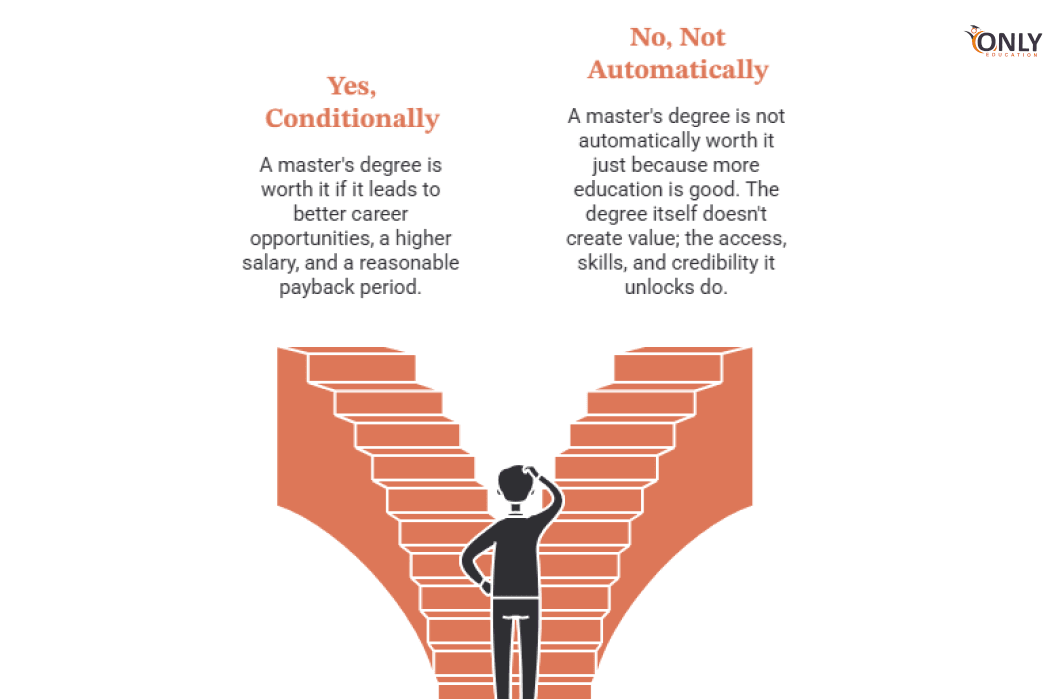
Three conditions tend to predict a strong outcome:
- Your target role or industry explicitly rewards or requires the credential (education, healthcare, government, core engineering, academia, and many specialised tech roles).
- You can complete it without taking on debt that exceeds roughly one year's expected post-degree salary.
- You have a specific reason for choosing the field, not just "I don't know what else to do."
If none of these apply, the case weakens considerably, and that's worth knowing before you apply, not after you graduate.
8 Evidence-Based Benefits of a Master's Degree
1. Higher Earning Potential: The Real Numbers for India
This is the benefit every competitor article leads with, and for good reason: it's measurable. Master's degree holders in India typically earn 20–30% more annually than those with only a bachelor's degree. On salary-aggregator data for 2026, the median annual salary reported for ""Master's"-qualified professionals sits around ₹13 lakh, with entry-level postgraduate roles starting near ₹10.25 lakh and experienced postgraduate professionals reaching ₹17.6 lakh or more.
The premium varies sharply by field, which is precisely the nuance most articles skip:
Field | Typical Salary Premium vs. Bachelor's Only |
| Data Science / AI / ML | 25–35%+ |
| Business Administration (MBA) | 20–50% (institution-dependent) |
| Computer Science / IT | 20–30% |
| Core Engineering | 15–25% |
| Healthcare / Public Health | 20–30% |
| Humanities / Arts | 10–20% |
The takeaway: averages mislead. A master's in a high-demand technical or managerial field can pay for itself in 2–3 years; a less targeted degree in a saturated field may take much longer or never fully close the gap.
2. Access to Senior and Leadership Roles
Many leadership, policy, and management-track roles list a master's degree as a baseline requirement, not a preference, especially in education administration, healthcare management, government services, and corporate strategy functions. The degree signals that you can manage complexity: multi-stage research, ambiguous problems, and long-horizon projects, which are exactly the skills senior roles demand.
3. Deep, Specialized Expertise Employers Pay For
A bachelor's degree gives you breadth. A master's degree gives you depth in one area, and depth is what differentiates candidates in a market where a bachelor's degree is now nearly universal among applicants. Most programmes also let you choose a concentration within your field (say, financial risk within an MBA or cybersecurity within computer science), so your expertise maps directly onto a specific job family rather than a generic discipline.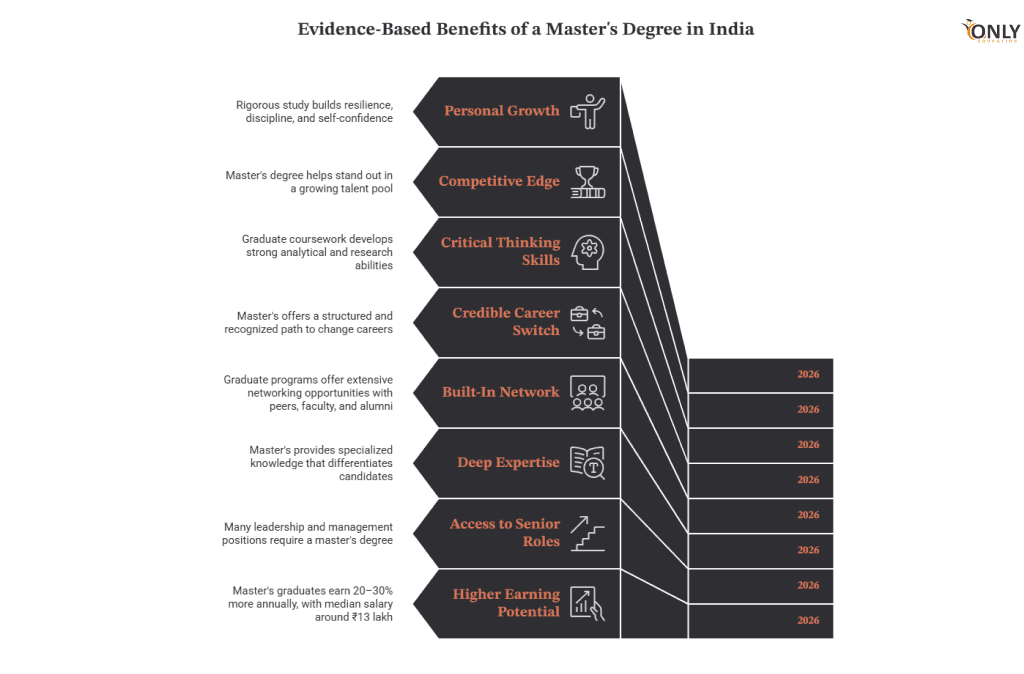
4. A Built-In Professional Network
Roughly 18–20% of professionals report finding their current job through networking. Graduate programmes compress years of networking into a couple of years: classmates already working in your target industry, faculty with active industry ties, structured internships, and alumni networks that often number in the tens or hundreds of thousands at established universities. These relationships routinely turn into referrals, mentorships, and direct hiring value that's real but easy to underweight when you're only comparing tuition to salary.
5. A Credible Path to Switch Careers
If you want to move from, say, mechanical engineering into data science, or from teaching into educational technology, a master's degree is often the fastest credible bridge. Many programmes are explicitly designed to admit students from adjacent or unrelated undergraduate backgrounds, then bring them up to professional competency within the programme, something a certification alone usually can't do for a genuine field switch.
6. Stronger Critical Thinking and Research Skills
Graduate coursework literature reviews, original research, data analysis, thesis or capstone projects build analytical rigour that's hard to replicate on the job. Employers consistently rank critical thinking and complex problem-solving among the most valued (and hardest to hire for) skills, and a completed master's is concrete evidence you can sustain that kind of work over months, not just in a single project sprint.
7. A Competitive Edge as the Talent Pool Grows
India's postgraduate output has grown substantially over the past decade, and global capability centres (GCCs), financial services, and e-commerce are projected to lead salary growth in 2026 (10%+ increments) in sectors that disproportionately hire credentialed, specialised talent. As more roles get contested by a larger pool of bachelor's-only applicants, a master's degree increasingly functions as a differentiator rather than a guarantee, similar to how a bachelor's degree itself functioned a generation ago.
8. Personal Growth and Long-Term Confidence
This benefit is harder to quantify but shows up consistently in graduate outcomes research: completing a rigorous, self-directed programme of study builds resilience, time-management discipline, and self-efficacy that outlasts any single job. Many graduates describe this as the benefit they didn't expect going in but value most looking back.
When a Master's Degree Is Not Worth It
No credible analysis of this topic should skip the failure modes. A master's degree tends to be a weak investment when:
- The field doesn't reward it. In some roles, particularly in sales, many startup environments, and parts of the creative industry, demonstrated portfolio work and experience outweigh credentials. A master's degree adds cost without proportionate access.
- You finance it with high-interest debt that exceeds what you can reasonably repay within 3–5 years of graduating, especially if the field's salary premium is on the lower end (10–20%).
- You choose the field by default, not by research. "I didn't know what else to do" rarely produces strong outcomes, because motivation and specialisation choice both suffer.
- The institution lacks accreditation or industry recognition. A degree from a UGC/AICTE/NAAC-recognised, well-ranked institution carries materially more hiring weight than an unaccredited or low-recognition programme, and that gap is widening as employers get more selective.
- Skills-based hiring already dominates your target field. In fast-moving tech subfields, demonstrated projects, certifications, and contributions can sometimes get you hired faster and cheaper than a 2-year programme is worth weighing honestly before you commit to it.
If two or more of these apply to your situation, slow down and run the ROI math in the next section before applying.
Master's Degree ROI: How to Calculate Your Own Payback Period
Skip the averages; calculate your own number with this formula:
Payback period (years) = Total cost of degree ÷ Annual salary increase you expect
The total cost should include tuition, fees, study materials, and, if you're studying full-time, the income you forgo by not working (or working less) during the programme.
Worked Example IT Professional
- Current salary: ₹6,00,000/year
- M.Tech (Computer Science) total cost (part-time, working): ₹4,00,000
- Expected salary post-degree: ₹8,50,000/year (≈42% increase, reflecting a senior technical role)
- Annual increase: ₹2,50,000
- Payback period: 4,00,000 ÷ 2,50,000 ≈ 1.6 years
Worked Example Career Switcher
- Current salary: ₹500,000/year (non-technical role)
- MBA (full-time, 2 years) total cost including forgone income: ₹18,00,000
- Expected salary post-degree: ₹9,00,000/year
- Annual increase: ₹4,00,000
- Payback period: 18,00,000 ÷ 4,00,000 = 4.5 years
Neither outcome is "wrong", but they tell very different stories about urgency and risk tolerance. Run your own numbers with realistic, field-specific salary data (not aspirational figures) before committing.
Master's Degree Cost in India (2026 Breakdown)
Degree Type | Typical Annual Tuition (₹) | Typical Duration |
| MBA | 5,00,000 – 20,00,000 | 1–2 years |
| MSc / M.Tech (Engineering, CS) | 2,00,000 – 8,00,000 | 2 years |
| MA (Humanities/Social Sciences) | 50,000 – 3,00,000 | 2 years |
| M.Ed | 1,00,000 – 4,00,000 | 1–2 years |
| MCA | 1,50,000 – 5,00,000 | 2 years |
Costs vary widely by institution tier, city, and whether the program is full-time, part-time, or online. Government and centrally funded institutions sit well below these ranges; top-tier private and international-collaboration programs sit at or above the top end. Always request a full fee breakdown (tuition + exam fees + project/lab fees + hostel, if applicable) before comparing programs.
Master's Degree vs. the Alternatives Comparison Table
Path | Typical Cost | Typical Time | Salary Impact | Best For |
| Master's Degree | ₹1L–₹20L | 1–2 years | 20–30%+ avg. increase | Roles requiring credentials; career pivots; research/leadership tracks |
| Professional Certification (e.g., PMP, data certifications) | ₹10K–₹2L | 2–6 months | 10–25% increase (field-dependent) | Fast, targeted skill-gap closing in a field you're already in |
| On-the-job experience / promotion | ₹0 (opportunity cost only) | 2–5 years | Varies widely | Fields where portfolio and track record outweigh credentials |
| MBA specifically | ₹5L–₹20L | 1–2 years | Often the highest premium of any single credential, esp. from top-ranked schools | Management/leadership track, career switchers into business roles |
| Second Master's Degree | ₹1L–₹15L | 1–2 years | Marginal unless it adds a genuinely new specialisation. | Deepening a niche or pivoting into an adjacent high-demand field |
Which Master's Degree Has the Best ROI in India?
Based on current salary-premium data and 2026 sector hiring growth (GCCs, financial services, e-commerce, and life sciences leading at 9.7–10.4% projected increments), the degrees showing the strongest ROI right now are:
- MS/M.Tech in Computer Science, AI, or Data Science: strongest demand-side pull from GCCs and tech hiring
- MBA from a NAAC/AICTE-accredited, well-ranked institution with the broadest applicability across leadership tracks
- M.Tech in Cybersecurity: fast-growing, talent-scarce niche
- MSc in Biotechnology / Life Sciences benefits from pharma and healthcare sector growth
- A master's in Finance / Financial Risk Management financial services is among the highest 2026 salary-growth sectors
This is directional, not a guarantee your specific institution, specialisation, and the strength of your portfolio/internships will move these numbers more than the degree title alone.
Master's Degree Worth It By Career Stage
Right After Your Bachelor's
Strong case if your field clearly rewards credentials early (engineering, sciences, research tracks) and you can avoid heavy debt. Weaker case if you haven't worked yet and aren't sure what specialisation actually interests you; work experience can sharpen that choice and is rarely wasted.
After 2–5 Years of Work Experience
Often the strongest ROI window. You bring real-world context to coursework, you know exactly which gaps a degree needs to fill, and many employers will support part-time study with fee reimbursement or schedule flexibility.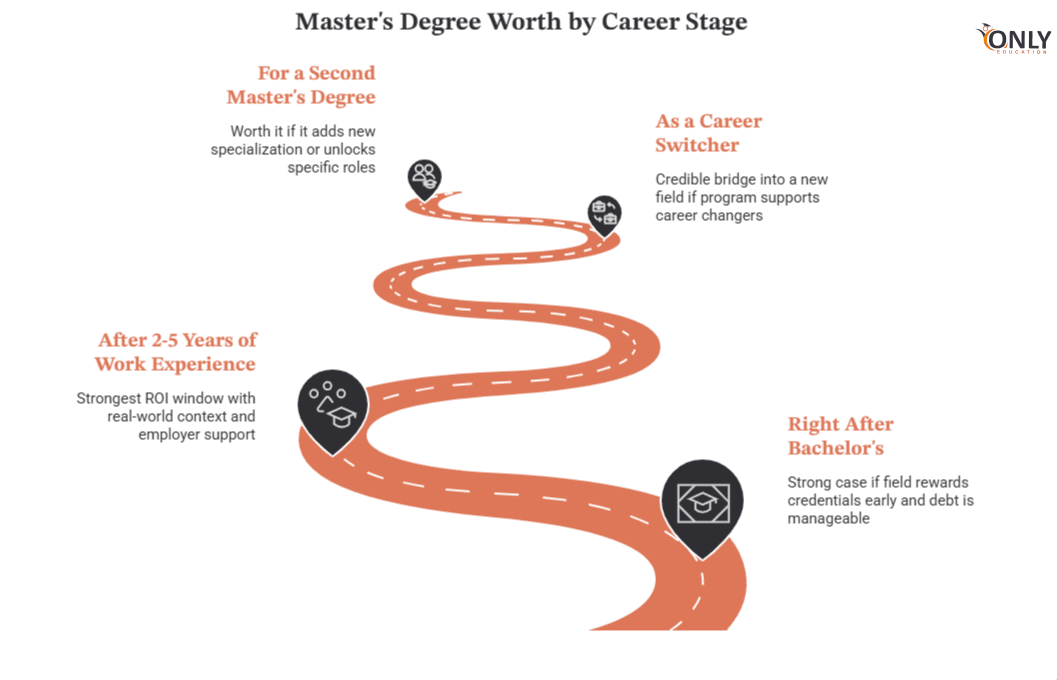
As a Career Switcher
A master's degree is frequently the most credible bridge into a genuinely new field, but verify the programme explicitly supports career changers (background-agnostic admissions and foundational coursework) rather than assuming any programme will work.
For a Second Master's Degree
Worth it only if it adds real, new specialisation or unlocks a specific role you couldn't access otherwise. A second degree in an adjacent field (e.g., adding an MBA to a technical master's for a path into tech leadership) tends to outperform a second degree that largely overlaps with the first.
Online vs. On-Campus: Which Format Makes It "Worth It"?
Factor | Online/Part-Time | On-Campus/Full-Time |
| Cost | Generally lower; no relocation/hostel costs | Generally higher; includes living costs |
| Income during study | You typically keep working | Often paused or reduced |
| Networking | Possible but requires more effort | Stronger daily in-person contact |
| Best for | Working professionals: career stability priority | Career switchers, research-heavy fields, those without current employment |
| Payback period | Often shorter (lower cost, income continues) | Often longer (forgone income adds to true cost) |
Neither format is inherently "more worth it" match the format to your financial situation and how much you depend on in-person networking and lab/practical access for your specific field.
A 5-Question Self-Assessment Before You Apply
- Does my target role or industry explicitly value or require a master's degree or am I assuming it does?
- Can I calculate a realistic payback period under 5 years using conservative (not best-case) salary estimates?
- Am I choosing this specific field because of genuine interest and market demand not just "more education is safe"?
- Can I fund this without debt that exceeds roughly one year of my expected post-degree salary?
- Is the institution accredited and recognized in my target industry (UGC/AICTE/NAAC, strong placement record, real industry partnerships)?
If you answered "yes" to four or five of these, the data strongly favours pursuing the degree. Two or fewer "yes" answers mean it's worth pausing to address the gaps, starting a certification or gaining more work experience first, then revisiting.
How to Choose the Right Master's Program
Once you've decided a master's degree makes sense, the programme you choose matters as much as the decision itself:
- Verify accreditation (UGC/AICTE recognition, NAAC grade, NIRF ranking where applicable) before anything else.
- Check placement data, not just placement percentage. Ask for average and median salaries, not just headline numbers.
- Talk to current students or recent alumni about faculty quality, industry exposure, and whether the curriculum stayed current with the field.
- Confirm specialization options align with the specific role you're targeting, not just the broad discipline.
- Compare total cost (not just tuition) across 3–4 shortlisted programmes before deciding.
Only Education offers accredited master's programmes [list your key disciplines e.g., engineering, business administration, computer applications, education] with strong industry placement partnerships.
FAQs
1. Is a master's degree worth it in 2026?
For most fields, yes, master's degree holders in India earn 20–30% more on average than bachelor's-only peers, and the credential remains close to mandatory for senior roles in education, healthcare, government, and core engineering. ROI varies sharply by field, so calculate your own payback period rather than relying on averages.
2. How much does a master's degree cost in India?
Costs range from roughly ₹50,000 to ₹20,00,000 per year depending on the degree type and institution MA and M.Ed programs sit at the lower end, while MBA programs from top-tier institutions sit at the upper end.
3. How long does a master's degree take to complete?
Most master's programs in India take 1–2 years full-time; part-time and online formats can extend this to 2–3 years depending on course load.
4. Does a master's degree guarantee a higher salary?
No single degree guarantees an outcome. On average, master's holders earn significantly more, but the increase depends heavily on field, institution, specialization, and individual performance not the credential alone.
5. Is a master's degree worth it without work experience?
It can be, particularly in research-heavy or technical fields where employers expect advanced training early. It's a weaker case if you're still unsure of your specialization, since work experience often clarifies that choice.
6. Is an online master's degree as valuable as an on-campus one?
Increasingly yes, provided the program is from an accredited, recognized institution. Employers weigh accreditation and curriculum rigor far more than delivery format today.
7. Is a second master's degree worth it?
Only if it adds genuinely new specialization or unlocks a role the first degree couldn't. A second degree that largely overlaps with your first rarely produces proportionate ROI.
8. What is the average salary increase after a master's degree in India?
Industry data points to a 20–30% average increase over bachelor's-only salaries, with high-demand technical and managerial fields often exceeding 30%.
9. Is an MBA worth it compared to other master's degrees?
MBAs from accredited, well-ranked institutions often show among the highest salary premiums of any single credential, particularly for career switchers moving into management. ROI depends heavily on institution reputation.
10. Which master's degree has the best ROI in India right now?
Based on current sector growth, computer science/AI/data science, cybersecurity, finance, and biotechnology master's degrees show particularly strong ROI in 2026, driven by hiring growth in GCCs, financial services, and life sciences.
11. Can I do a master's degree while working full-time?
Yes, many programmes offer part-time, evening, weekend, or fully online formats designed specifically for working professionals, allowing you to keep earning while studying.
12. Is a master's degree necessary to get a good job in India?
Not universally. It's close to essential in education, healthcare, government services, academia, and core engineering, but many tech, sales, and creative roles increasingly weight skills, portfolios, and certifications as heavily as degrees.
13. What are the disadvantages of a master's degree?
The main risks are high cost (especially if debt-financed), 1-2 years of reduced or paused income, choosing a low-ROI field, and attending an unaccredited or low-recognition institution.
14. How do I calculate the ROI of a master's degree?
Divide your total cost (tuition plus any forgone income) by your expected annual salary increase to get your payback period in years. A payback period under 5 years is generally considered a strong outcome.
15. Is a master's degree worth it for a career change?
Often yes it's frequently the fastest credible bridge into a genuinely new field, especially for programs designed to admit students from unrelated undergraduate backgrounds.
16. Do employers in India prefer master's degree holders?
Many do, particularly for senior and specialised roles, though skills-based hiring is growing. Recent industry surveys show a majority of employers now weighing certifications and demonstrated competencies alongside (not instead of) degrees.
17. What's the difference between an MA, MSc, and MBA?
An MA focuses on humanities and social sciences, an MSc (or MS) focuses on technical and scientific fields, and an MBA focuses on business and management; each builds different specialized expertise for different career tracks.
18. Is it better to do a master's degree right after a bachelor's or after working?
Both have a case. Right after a bachelor's suits fields that reward early specialization (engineering, research); after a few years of work often produces stronger ROI because you enter with clearer goals and sometimes employer support.
19. How do I know if a master's program is accredited in India?
Check for UGC recognition, AICTE approval (for technical programs), and a NAAC grade; these are the baseline indicators employers and other institutions look for when evaluating a degree's credibility.
20. Is a master's degree worth the debt?
It depends on the payback period. If your total debt is roughly equal to or less than one year's expected post-degree salary, and your field has a strong salary premium, the maths typically favours proceeding. Beyond that, the risk rises significantly.
The Bottom Line
A master's degree is worth it when the maths closes, not because advanced education is inherently good. Run your own payback-period calculation; verify your target field and institution both reward the credential, and avoid financing it with debt that outpaces realistic salary growth. Done deliberately, a master's degree remains one of the most reliable ways to raise your earning ceiling, unlock leadership roles, and build a professional network that compounds for the rest of your career.
Ready to explore accredited postgraduate programmes? Contact us at +916262929248. For More Information